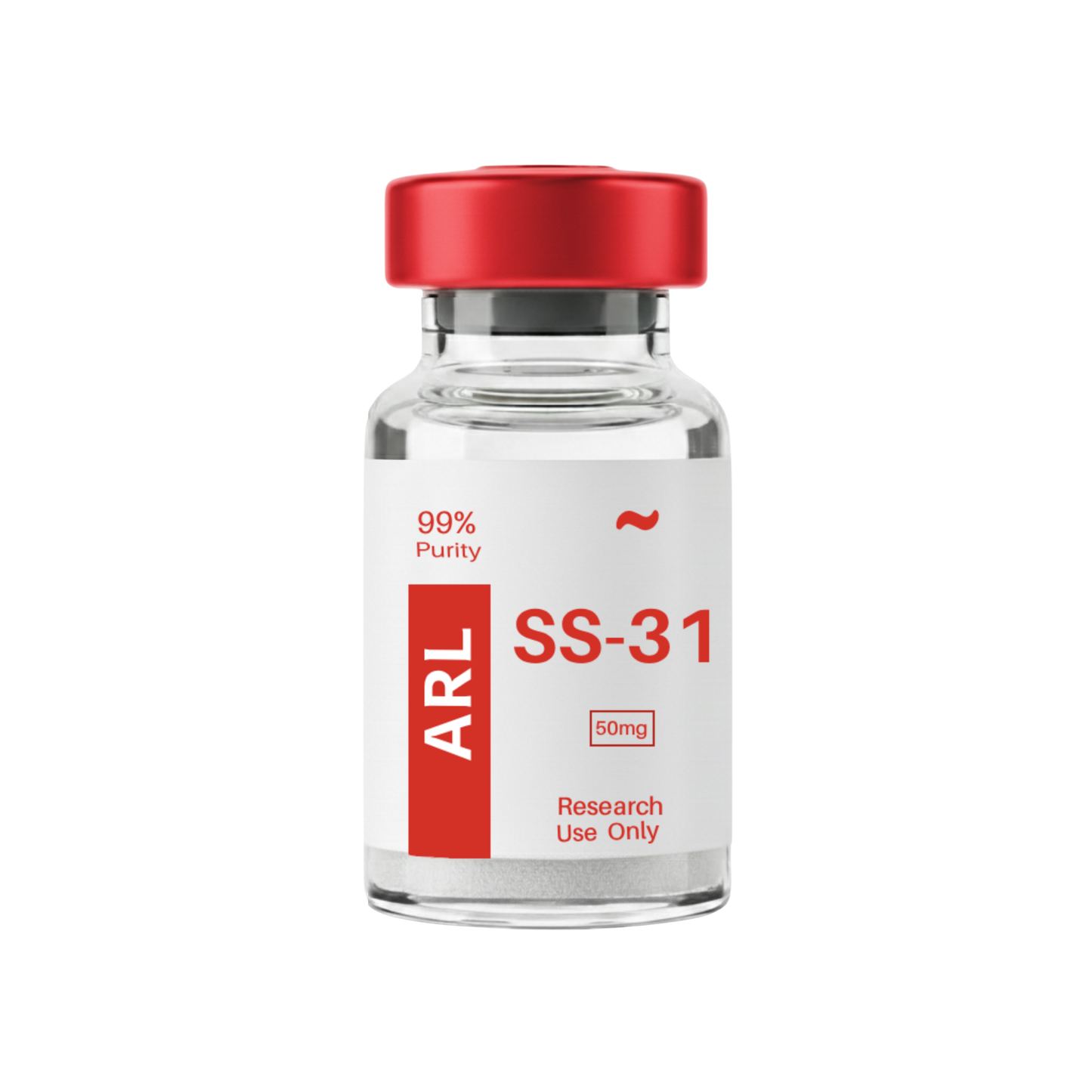
SS-31
SS-31
This batch of SS-31 (Elamipretide) Mitochondrial Peptide has been third party lab tested and verified for quality.
Contents: SS-31
Form: Powder
Purity: 99.5%
Couldn't load pickup availability
Free Reconstitution Solution automatically added to your cart with each order.
This product is Made, Tested & Shipped From Canada.
Ships Today
Order by 1:00 PM EST
Free Shipping
For 2 or more vials
Verified+

Mito-Inflammation Research Peptide (SS-31) Technical Brief
1. Introduction
This document provides a technical overview of the Mito-Inflammation Research Peptide, SS-31 (D-Arg-Dmt-Lys-Phe-NH2), and its role as a modulator of the "mitochondrial-inflammatory axis." Recent advances in cellular biology have established mitochondria not merely as powerhouses of the cell but as central signaling hubs that dictate cellular fate, particularly in the context of inflammation and stress. The precise and localized action of SS-31 offers a valuable tool for researchers investigating these complex connections.
2. Scientific Background: The Mitochondrial-Inflammatory Axis
Mitochondrial dysfunction is intrinsically linked to the initiation and propagation of inflammatory responses. This connection, often termed the mitochondrial-inflammatory axis, involves the release of damage-associated molecular patterns (DAMPs) and the activation of key signaling pathways. SS-31 is a tetrapeptide that selectively targets the inner mitochondrial membrane (IMM) where it modulates critical aspects of this axis.
2.1. Focus: Modulating the Mitochondrial-Inflammatory Axis
The primary utility of the Mito-Inflammation Research Peptide (SS-31) stems from its ability to counteract inflammatory signaling pathways rooted in mitochondrial stress. This compound modulates several key cellular processes, making it a multifaceted tool for research.
2.2. Signaling Pathway Inhibition
SS-31 has been shown to interfere with primary inflammatory signaling cascades, specifically those driven by mitochondrial reactive oxygen species (mtROS).
Target Pathway
Mechanism of Action
Inflammatory Outcome
NF-kappaB Signaling
Inhibited directly or via upstream mtROS scavenging
Reduced nuclear translocation of NF-kappaB
Inflammatory Cytokines
Downregulation of expression
Decreased release of pro-inflammatory factors (e.g., IL-6, TNF-$\alpha$)
CD-36 Expression
Observed downregulation
Modulated fatty acid uptake and inflammatory macrophage activity
This dual-action modulation of both the upstream (mtROS) and downstream (NF-kappaB/Cytokine) signaling arms makes SS-31 a robust inhibitor for in vitro inflammation assays.
3. Mitochondrial Dynamics and Morphology
Mitochondrial health is critically dependent on a continuous cycle of fission (fragmentation) and fusion. Under cellular stress, an imbalance favoring excessive fission often precedes cellular dysfunction and inflammatory signaling.
3.1. Regulation of Fission/Fusion Proteins
SS-31 is implicated in regulating the expression of key proteins governing mitochondrial dynamics. Research suggests that SS-31:
- Regulates FIS1 expression: FIS1 (Fission 1) is a protein central to the mitochondrial fragmentation process during stress. By modulating FIS1, SS-31 helps preserve tubular, functional mitochondrial networks, which are less prone to releasing pro-inflammatory signals.
- Promotes Mitostasis: The overall effect is a shift toward mitochondrial homeostasis (Mitostasis), limiting the accumulation of damaged organelles that can trigger inflammation.
4. Apoptotic Pathway Modulation
Severe or unresolvable mitochondrial dysfunction often leads to the intrinsic apoptotic (cell death) pathway, a process that can, in some contexts, be highly inflammatory.
4.1. Preventing Cytochrome c Release
A critical step in the intrinsic apoptotic cascade is Mitochondrial Outer Membrane Permeabilization (MOMP), which results in the release of Cytochrome c from the intermembrane space into the cytosol.
- Mechanism: SS-31 is being investigated for its ability to stabilize the inner mitochondrial membrane structure and function, which indirectly prevents the permeabilization of the outer membrane.
- Outcome: The stabilization limits the release of Cytochrome c, thereby preventing the activation of downstream caspases and subsequent apoptotic pathways. This protective mechanism is vital in models of cellular stress where cell viability is paramount.
Pathway
Critical Step Affected
Research Focus of SS-31
Apoptosis
Cytochrome c release
Inhibition of MOMP
Inflammation
NF-kappaB activation
Scavenging of mtROS
Morphology
Mitochondrial fragmentation
Modulation of FIS1
5. Applications for Research and Usage
The Mito-Inflammation Research Peptide (SS-31) is strictly for research use only and is a valuable tool for specific in vitro and cellular models.
5.1. Intended Research Applications
SS-31 is optimized for use in the following research contexts:
- In Vitro Inflammation Assays: Used to investigate the role of mitochondrial integrity in models of LPS-induced inflammation, cytokine stimulation, or other inflammatory challenges in cell lines (e.g., macrophages, endothelial cells).
- Cellular Stress Models: Applied in models simulating oxidative stress, nutrient deprivation, or ischemia/reperfusion to determine the compound's effect on mitochondrial dynamics, mtROS production, and cell viability.
- Mitochondrial Dynamics Studies: Employed to isolate the effects of FIS1-related fission on overall cell health and inflammatory output.
5.2. Recommended Usage Guidelines (General)
Parameter
Guideline
Notes
Purity
>98% (HPLC)
Ensures reliable experimental results.
Formulation
Lyophilized powder
Store at -20°C or below.
Reconstitution
Sterile water or appropriate buffer
Consult specific protocol for solvent compatibility.
Working Concentration
Determined by cell line and assay; typical range is low micromolar (nM to $\mu$M).
Storage (Solution)
Aliquot and store at -20°C
Minimize freeze-thaw cycles to preserve integrity.
6. Detailed Mechanistic Hypotheses
Further research with SS-31 can explore the following mechanistic pathways in greater detail:
6.1. Interaction with Cardiolipin
SS-31 is known to preferentially localize to the inner mitochondrial membrane due to its interaction with cardiolipin, a unique phospholipid concentrated there. This interaction is hypothesized to:
- Stabilize the IMM: By associating with cardiolipin, SS-31 may help maintain the membrane's structural integrity, which is crucial for electron transport chain (ETC) function and preventing mtROS leakage.
- Enhance ETC Efficiency: Improved IMM structure may lead to more efficient electron transfer, reducing the formation of superoxide at Complexes I and III, a major source of inflammatory mtROS.
6.2. Feedback Loop Disruption
The mitochondrial-inflammatory axis operates through a damaging feedback loop: Mitochondrial Stress $\rightarrow$ mtROS $\rightarrow$ NF-kappaB Activation $\rightarrow$ Cytokine Release $\rightarrow$ Cellular Damage $\rightarrow$ Increased Mitochondrial Stress. SS-31 is believed to effectively disrupt this cycle by acting as an antioxidant at the primary source (IMM), thereby preventing the feed-forward loop of inflammation.
7. Comparative Research Data (Illustrative)
Researchers utilizing SS-31 have observed significant differences in inflammatory markers compared to control groups in various cellular models.
A comparative analysis of NF-kappaB activity post-treatment with SS-31 in stimulated macrophages is shown below.
Treatment Group
NF-kappaB Nuclear Translocation (Relative Units)
Cytokine Expression (Fold Change)
Untreated Control
Date
Date
Inflammatory Stimulus Only
High
4.5
Stimulus + SS-31
Low-Moderate
1.2
Stimulus + Standard Antioxidant
Moderate
2.5
[A bar chart representing NF-kappaB Nuclear Translocation in different treatment groups]
8. Safety and Handling
The Mito-Inflammation Research Peptide is a synthetic peptide intended solely for in vitro and research applications. It is not approved for human consumption or therapeutic use.
- Handling: Appropriate laboratory personal protective equipment (PPE), including gloves, lab coats, and eye protection, must be worn when handling the lyophilized powder and reconstituted solution.
- Disposal: Dispose of SS-31 and related waste materials in accordance with institutional biosafety and chemical disposal protocols.
A Material Safety Data Sheet (MSDS) is available for comprehensive safety information. Please contact Person at File for the latest version.
9. Next Steps in Research
The ongoing investigation into SS-31 is focused on translating its observed cellular benefits into defined mechanisms in complex inflammatory conditions. Future research directions include:
- Elucidating FIS1-independent mechanisms: Determining if SS-31 modulates other mitochondrial fission or fusion proteins (e.g., DRP1, OPA1).
- Defining Concentration Dependence: Establishing precise dose-response curves for maximum anti-inflammatory and anti-apoptotic effects across different cell types.
- Investigating In Vivo Potential (Pre-clinical): Studying the compound's stability, bioavailability, and efficacy in relevant animal models of inflammation-driven disease.
10. Conclusion
SS-31 remains a powerful and specific tool for researchers focusing on the pivotal connection between mitochondria and inflammation. Its targeted action at the inner mitochondrial membrane, coupled with its ability to inhibit NF-kappaB and stabilize mitochondrial dynamics, provides a unique opportunity to decouple the feed-forward inflammatory pathways often initiated by cellular stress. This technical brief serves as a foundation for researchers initiating studies with the Mito-Inflammation Research Peptide. For experimental protocols or to discuss potential collaborations, please reach out to our research support team. You can find detailed usage protocols and literature reviews on our main project page, which will be discussed at the upcoming Calendar event.
-
check_circle
HIGHEST QUALITY PEPTIDES
Our products are scientifically formulated and manufactured in cGMP-compliant facilities.
-
encrypted
FAST DELIVERY
Enjoy fast and reliable 3–5 day shipping.
-
check_circle
Dedicated Customer Service
Our customer service team is highly knowledgeable in peptide research and its applications. We’re available 24/7 to assist you.
Verified reviews
Tested. Verified. Trusted.
We take a laboratory-first approach to quality. Each batch is made under controlled conditions and verified by an independent lab (HPLC/MS). We only ship batches that test ≥99% purity, and we provide a full COA, including identity, methods, and chromatograms, for your review.
You may also like
-
SAVE 25%Tirzepatide
Regular price From $50.00Regular price From $50.00 Sale priceUnit price / per$67.0025% -
SAVE 23%Tesamorelin
Regular price From $80.00Regular price From $80.00 Sale priceUnit price / per$105.0023% -
SAVE 23%Survodutide
Regular price $299.00Regular price $299.00 Sale priceUnit price / per$392.0023% -
SAVE 26%Sterile Water
Regular price From $14.00Regular price From $14.00 Sale priceUnit price / per$19.0026% -
SAVE 23%SLU-PP-332
Regular price $125.00Regular price $125.00 Sale priceUnit price / per$164.0023% -
SAVE 23%Sermorelin
Regular price From $70.00Regular price From $70.00 Sale priceUnit price / per$92.0023% -
SAVE 23%Semaglutide
Regular price From $36.00Regular price From $36.00 Sale priceUnit price / per$47.0023% -
SAVE 23%Retatrutide Triple Agonist
Regular price From $90.00Regular price From $90.00 Sale priceUnit price / per$118.0023% -
SAVE 26%Oxytocin Acetate
Regular price $42.00Regular price $42.00 Sale priceUnit price / per$57.0026% -
SAVE 25%Melanotan II (MT2)
Regular price $50.00Regular price $50.00 Sale priceUnit price / per$67.0025% -
SAVE 24%Lipo-C with B Vitamins
Regular price $85.00Regular price $85.00 Sale priceUnit price / per$112.0024% -
SAVE 23%Lemon Bottle
Regular price $80.00Regular price $80.00 Sale priceUnit price / per$105.0023% -
SAVE 23%L-Carnitine
Regular price $97.00Regular price $97.00 Sale priceUnit price / per$127.0023% -
KLOW Blend - GHK-CU + TB-500 + BPC-157 + KPV 10mg
Regular price $200.00Regular price $200.00 Sale priceUnit price / per$261.0023% -
SAVE 23%Kisspeptin-10
Regular price From $65.00Regular price From $65.00 Sale priceUnit price / per$85.0023% -
SAVE 23%Ipamorelin
Regular price From $32.00Regular price From $32.00 Sale priceUnit price / per$42.0023% -
SAVE 24%IGF-1 LR3 (Long R3)
Regular price From $40.00Regular price From $40.00 Sale priceUnit price / per$53.0024% -
SAVE 24%Hyaluronic Acid
Regular price $28.00Regular price $28.00 Sale priceUnit price / per$37.0024% -
SAVE 23%HGH Fragment 176-191
Regular price $97.00Regular price $97.00 Sale priceUnit price / per$127.0023% -
SAVE 23%HGH 191AA (Somatropin)
Regular price From $55.00Regular price From $55.00 Sale priceUnit price / per$72.0023% -
SAVE 25%Gonadorelin
Regular price $50.00Regular price $50.00 Sale priceUnit price / per$67.0025% -
SAVE 23%Glutathione
Regular price $83.00Regular price $83.00 Sale priceUnit price / per$109.0023% -
SAVE 23%Glow BPC-157 + GHK-CU + TB-500
Regular price $139.00Regular price $139.00 Sale priceUnit price / per$181.0023% -
SAVE 25%Epitalon (Epithalon)
Regular price From $50.00Regular price From $50.00 Sale priceUnit price / per$67.0025% -
SAVE 24%Dermorphin
Regular price $56.00Regular price $56.00 Sale priceUnit price / per$74.0024% -
SAVE 23%CJC-1295 with DAC
Regular price $139.00Regular price $139.00 Sale priceUnit price / per$182.0023% -
SAVE 23%CJC-1295 No DAC & Ipamorelin
Regular price $95.00Regular price $95.00 Sale priceUnit price / per$124.0023%
Every vial we sell comes from a lab that follows current Good Manufacturing Practices (cGMP). That means each step of production is documented and controlled. Before a batch is released, it’s tested by independent third-party labs for purity, identity, and sterility. Certificates of analysis are available so you can see the exact test results.
Yes. The labs we work with use ISO-certified clean rooms where air quality, equipment, and handling procedures are tightly regulated. Staff are trained to pharmaceutical-grade standards. This ensures the peptides are produced in an environment that minimizes contamination risks.
Peptides in lyophilized (freeze-dried) form are stable at room temperature for transport. Once you receive them, refrigeration is recommended to maintain long-term integrity. We package every order securely to prevent damage and ship promptly, so your vials arrive in optimal condition.
We operate under strict in-house protocols that follow current Good Manufacturing Practices (cGMP). That means our team oversees the entire process from sourcing raw amino acids to the final lyophilized vial. Nothing is outsourced or repackaged. This gives us full control over purity, consistency, and sterility, and it’s why we can stand behind every single vial we ship.
Store them in the refrigerator, away from direct light and heat. If you need to keep them longer, some peptides can be stored frozen. Each vial comes with clear handling instructions so you know the proper conditions for stability.
The strongest proof is transparency. For every peptide, we can provide certificates of analysis, manufacturing documentation, and references to the published scientific research behind it. If you ever have questions, we’ll show you the data rather than ask you to take our word for it.
The difference is transparency. Most sites give you a product name and a price. We provide full batch testing, lab documentation, and direct access to certificates of analysis so you don’t have to guess what you’re getting. When you order from us, you know exactly what’s in the vial, where it was made, and how it was verified.