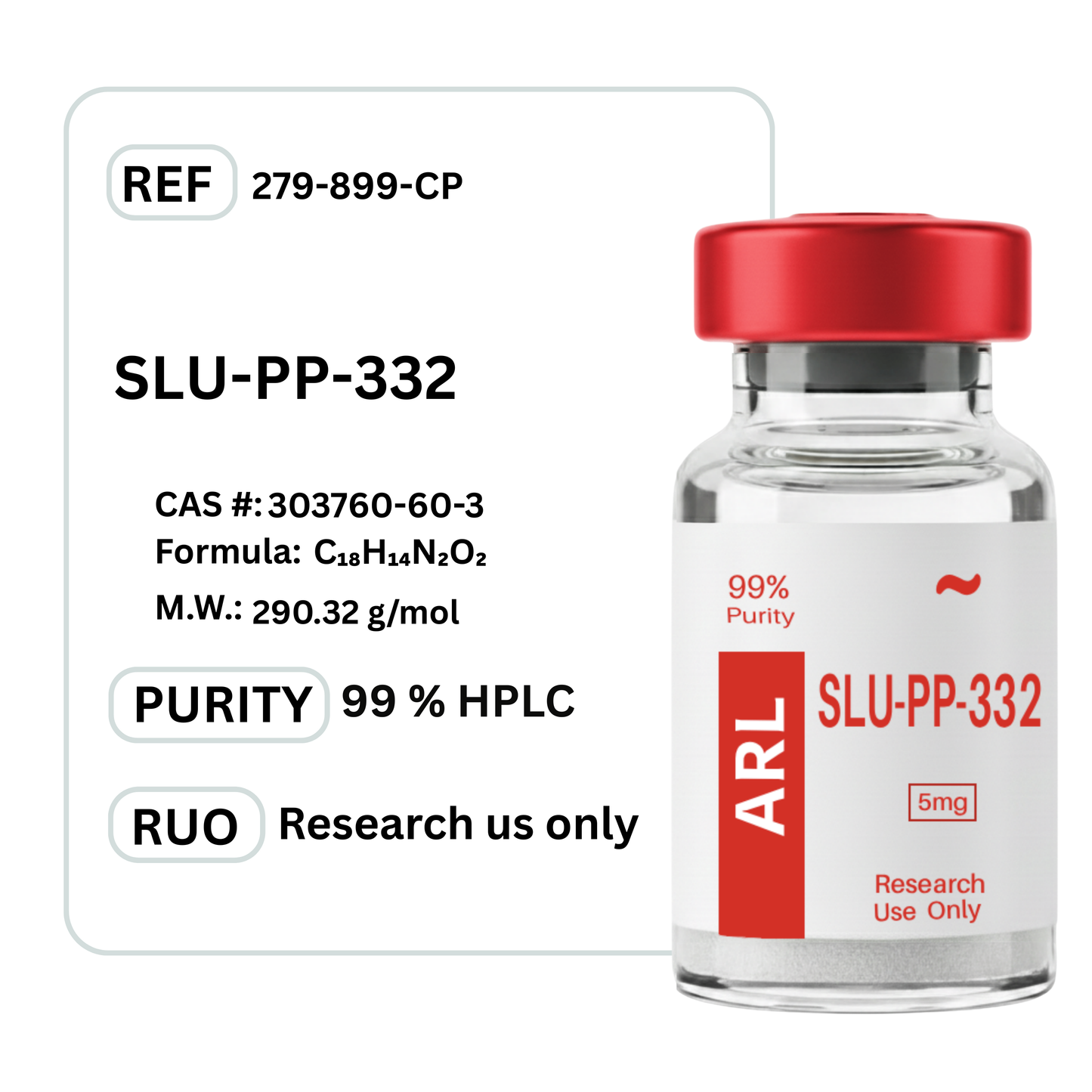
SLU-PP-332
SLU-PP-332
This batch of SLU-PP-332 Peptide has been third party lab tested and verified for quality.
Contents: SLU-PP-332 (PPARδ/PPARα Modulator)
Form: Powder
Purity: 99.3%
Couldn't load pickup availability
Free Reconstitution Solution automatically added to your cart with each order.
This product is Made, Tested & Shipped From Canada.
Ships Today
Order by 1:00 PM EST
Free Shipping
For 2 or more vials
Verified+

Neuro-Metabolic Research Ligand (ERRγ Agonist): Investigating Neurodegenerative Models
1. Introduction: Focus on Brain Health and Neurodegeneration
The global health challenge posed by neurodegenerative diseases necessitates the continuous development of novel research tools and therapeutic targets. This document introduces the Neuro-Metabolic Research Ligand (tentatively referred to as an ERRγ Agonist), a critical tool for investigating the intricate relationship between metabolic dysfunction and neuronal health, particularly focusing on the Estrogen-Related Receptor Gamma (ERRγ).
ERRγ is an orphan nuclear receptor that plays a pivotal, non-redundant role in regulating mitochondrial biogenesis, oxidative metabolism, and cellular energy homeostasis in high-energy-demand tissues, including the brain. Its activity is particularly critical for neuronal survival and function, making it a highly attractive target for modeling and mitigating neurodegenerative processes.
The specific ligand described here is designed for precision research, enabling scientists to modulate ERRγ activity in vitro and in vivo to unravel its protective mechanisms against various neurotoxic insults characteristic of diseases like Parkinson's and Alzheimer's.
2. Scientific Background: ERRγ Receptor and Neuronal Metabolism
The ERRγ receptor is an essential transcriptional regulator whose expression and activity are highly localized in regions of the brain most susceptible to metabolic stress and neurodegeneration, such as the substantia nigra and hippocampus.
2.1. Critical Role in Neuronal Survival
ERRγ is directly involved in maintaining energy flow within the neuron. It controls the transcription of genes encoding proteins for the electron transport chain (ETC), ATP synthesis, and the coordination of mitochondrial dynamics (fission and fusion). Disruption of these processes is a hallmark of many neurodegenerative disorders, suggesting that ERRγ modulation may represent a key pathway for restoring cellular resilience.
2.2. Neurodegenerative Disease Models
The research ligand is particularly relevant for studies addressing the following pathological mechanisms:
Disease Model
Key Pathological Feature
ERRγ Agonist Intervention Focus
Parkinson's Disease (PD)
Mitochondrial dysfunction, α-synuclein aggregation
Mitigating synuclein-induced toxicity, restoring mitochondrial integrity
Alzheimer's Disease (AD)
Amyloid-beta and tau pathology, cerebral hypometabolism
Enhancing glucose utilization, clearance of toxic protein aggregates
Huntington's Disease (HD)
Impaired autophagy and proteasomal degradation
Regulating genes involved in cellular waste clearance
Amyotrophic Lateral Sclerosis (ALS)
Oxidative stress and excitotoxicity
Promoting antioxidant defenses and enhancing energy production
3. Focus: Parkinson's Disease and Mitochondrial Function
The research ligand is intensely focused on Parkinson's Disease (PD) models, where mitochondrial dysfunction is recognized as a primary driver of dopaminergic neuron death.
3.1. Mitochondrial Dysfunction in Dopaminergic Neurons
Dopaminergic neurons, particularly those in the substantia nigra pars compacta, are intrinsically susceptible to mitochondrial stress due to their high metabolic rate and reliance on dopamine metabolism, which generates reactive oxygen species. The Neuro-Metabolic Research Ligand specifically investigates the role of mitochondrial dysfunction by:
- Promoting Biogenesis: Upregulating PGC-1α, a master regulator of mitochondrial biogenesis, via ERRγ activation.
- Improving ETC Efficiency: Restoring complex I and III activity, which are often impaired in PD pathology.
- Maintaining Mitochondrial Quality: Supporting the process of mitophagy (selective clearance of damaged mitochondria).
3.2. Mitigating Synuclein-Induced Toxicity
Experimental data suggest that ERRγ activation, potentially via compounds structurally related to SLU-PP-332, may mitigate synuclein-induced toxicity. The precise mechanism involves:
- Reducing Oxidative Stress: By optimizing mitochondrial function, the ligand minimizes the production of reactive oxygen species (ROS), thereby protecting cellular components from damage induced by aggregated $\alpha$-synuclein.
- Enhancing Clearance: Promoting the removal of toxic $\alpha$-synuclein oligomers through improved autophagic flux.
The study of this ligand offers a direct avenue to test the hypothesis that metabolic correction is a viable strategy for PD neuroprotection.
4. Mechanisms of Action: Gene Expression and Autophagy
The therapeutic potential of this research ligand stems from its ability to orchestrate the transcription of key metabolic and proteostasis genes.
4.1. Regulation of Gene Expression
Activation of ERRγ by the ligand regulates genes involved in autophagy and synaptic vesicle cycling, two essential processes that are frequently impaired in neurodegeneration.
Regulated Gene Pathway
Function in Neuronal Health
Impact of Ligand Activation
Autophagy (e.g., LC3, ATG genes)
Cellular self-cleaning process, clearance of protein aggregates and damaged organelles
Enhances lysosomal degradation and removal of pathological proteins
Synaptic Vesicle Cycling (e.g., Synaptophysin, VAMP2)
Maintains synaptic communication and neurotransmitter release
Supports synaptic plasticity and combats synaptic loss in early disease stages
Mitochondrial Biogenesis (e.g., TFAM, NRF1)
Creation of new, healthy mitochondria
Increases energy supply and reduces susceptibility to metabolic failure
4.2. Autophagic Flux Enhancement
In neurodegenerative diseases, autophagic flux is often blocked or impaired, leading to the accumulation of misfolded proteins. The ERRγ Agonist is hypothesized to act as a potent enhancer of autophagic capacity, ensuring that misfolded proteins (like $\alpha$-synuclein or hyperphosphorylated tau) are efficiently sequestered and degraded.
5. Neuroprotection and Disease Progression
A major focus of the research surrounding this ligand is its potential to prevent the formation of Lewy bodies and delay disease progression.
5.1. Preventing Lewy Body Formation
Lewy bodies, the pathological hallmark of PD and Lewy Body Dementia, are primarily composed of aggregated $\alpha$-synuclein. By reducing $\alpha$-synuclein toxicity and promoting its clearance via autophagy (Section 4), the ligand is explored as a tool to inhibit the initial misfolding and subsequent aggregation steps. Studies using this ligand should focus on quantifying soluble vs. aggregated synuclein species and characterizing the morphological changes in dopaminergic cell cultures.
5.2. Delaying Disease Progression
Delaying progression requires maintaining the functional integrity of neurons under chronic stress. This ligand offers a research pathway to:
- Preserve Dopaminergic Markers: Assessing the maintenance of Tyrosine Hydroxylase (TH) expression and dopamine transporter (DAT) function in in vitro and animal models of PD.
- Measure Neuronal Survival: Quantifying the number of viable neurons over extended culture periods following neurotoxic challenge (e.g., treatment with MPP+, rotenone, or exposure to pre-formed $\alpha$-synuclein fibrils).
- Evaluate Behavioral Outcomes: In animal models, measuring motor function, coordination, and cognitive performance to correlate metabolic health with functional outcomes.
6. Usage and Application Guidelines
The Neuro-Metabolic Research Ligand is a powerful chemical probe for basic and translational neuroscience research.
6.1. Recommended Usage
This ligand is recommended for in vitro neuroprotection assays and neurodegenerative disease models.
- Cell Culture Models: Primary neuronal cultures (e.g., cortical, hippocampal, mesencephalic), induced pluripotent stem cell (iPSC)-derived neurons, and neuroblastoma cell lines.
- Assay Types:
- Mitochondrial function assays (e.g., Seahorse analysis for Oxygen Consumption Rate - OCR).
- Viability and toxicity screens (e.g., MTT, LDH assays).
- Gene and protein expression studies (qPCR, Western Blot) targeting metabolic pathways (PGC-1α, ERRγ targets).
- Fluorescence imaging of $\alpha$-synuclein or tau aggregation.
6.2. In Vitro Neuroprotection Assay Protocol Snippet
A typical in vitro protocol involves establishing a neurotoxic environment and assessing the ligand's ability to rescue the neurons.
Step
Action
Endpoint Measurement
1. Establish Culture
Plate primary neurons or iPSC-derived neurons at Date density in appropriate media.
Cell attachment and viability
2. Ligand Treatment
Pre-treat cells with varying concentrations of the research ligand for 24-48 hours.
Optimal dosage range (LD50 determination)
3. Neurotoxic Challenge
Add a neurotoxin (e.g., 1-2 $\mu$M Rotenone or Date nM $\alpha$-synuclein PFFs).
Acute toxicity induction
4. Assessment
After 72 hours, assess cell viability, ATP levels, and apoptosis markers.
Neuroprotective efficacy of the ligand
For a detailed protocol, refer to the accompanying documentation: File.
7. Extended Research Applications
Beyond Parkinson's disease, the metabolic regulatory function of ERRγ makes this ligand a valuable probe for other conditions.
7.1. Alzheimer's Disease (AD)
Cerebral glucose hypometabolism is one of the earliest signs of AD, preceding amyloid and tau pathology. The ERRγ agonist can be used to investigate:
- The ability to boost neuronal glucose uptake and utilization in AD models.
- The connection between enhanced metabolism and reduced tau hyperphosphorylation.
7.2. Traumatic Brain Injury (TBI) and Stroke
Both TBI and ischemic stroke result in acute metabolic crisis and mitochondrial failure. The ligand can be utilized to study:
- The immediate neuroprotective effects of metabolic support following acute injury in vitro and in vivo.
- The potential for ERRγ activation to limit excitotoxicity and secondary injury cascades.
7.3. General Metabolic Disorders
Given ERRγ's role in whole-body metabolism, this ligand may also be used in non-neuronal cells (e.g., muscle, liver) to explore links between systemic metabolic health and neurological outcomes, a field known as the gut-brain axis. Researchers interested in this area should consult the resources available from Person.
8. Safety and Handling
This research ligand is intended strictly for in vitro and specialized in vivo laboratory use by trained professionals.
8.1. Material Safety Data
The safety data sheet (SDS) for this compound can be accessed via: File. Key considerations include:
- Physical State: Solid powder, storage at -20°C.
- Hazards: May cause irritation. Handle under a fume hood.
- Disposal: Dispose of as chemical waste according to local regulations at the Place facility.
8.2. Stock Solution Preparation
Always prepare stock solutions fresh in high-quality, sterile DMSO. Recommended maximum stock concentration is 10 mM. Working concentrations should not exceed $10 \mu$M to minimize solvent toxicity, though optimal concentration is highly assay-dependent.
A dedicated workshop on best practices for handling and use will be held on Date. You can register here: Calendar event.
9. Future Research Directions
The development of the Neuro-Metabolic Research Ligand opens up several promising avenues for future investigation:
9.1. Structure-Activity Relationship (SAR) Studies
Further optimization of the compound's structure is necessary to improve its blood-brain barrier (BBB) penetration, potency, and selectivity. Collaboration with medicinal chemists at the Place institute is ongoing to generate next-generation analogs.
9.2. Combination Therapies
Investigating the synergistic effects of combining the ERRγ agonist with other known neuroprotective agents, such as antioxidants or inhibitors of specific neuroinflammatory pathways. For instance, combining the ligand with an Nrf2 activator could significantly enhance neuronal resilience.
9.3. Predictive Biomarkers
The ligand can be used to identify peripheral biomarkers (e.g., in blood or cerebrospinal fluid) that reflect ERRγ activation and metabolic improvement in the central nervous system. This is crucial for translating in vitro findings into clinical trial endpoints.
10. Conclusion and Research Support
The Neuro-Metabolic Research Ligand represents a significant advancement in the research toolkit for studying metabolic failure in neurodegeneration. By precisely targeting the ERRγ receptor, researchers can gain deeper insights into the fundamental mechanisms of neuronal energy crisis, leading to the development of disease-modifying strategies.
For technical support, ordering information, or to discuss collaborative research opportunities, please contact the lead investigator, Dr. Person, or attend our next Q&A session: Calendar event. We are committed to supporting your exploration of brain health and neurodegenerative models.
-
check_circle
HIGHEST QUALITY PEPTIDES
Our products are scientifically formulated and manufactured in cGMP-compliant facilities.
-
encrypted
FAST DELIVERY
Enjoy fast and reliable 3–5 day shipping.
-
check_circle
Dedicated Customer Service
Our customer service team is highly knowledgeable in peptide research and its applications. We’re available 24/7 to assist you.
Verified reviews
Tested. Verified. Trusted.
We take a laboratory-first approach to quality. Each batch is made under controlled conditions and verified by an independent lab (HPLC/MS). We only ship batches that test ≥99% purity, and we provide a full COA, including identity, methods, and chromatograms, for your review.
You may also like
-
SAVE 25%Tirzepatide
Regular price From $50.00Regular price From $50.00 Sale priceUnit price / per$67.0025% -
SAVE 23%Tesamorelin
Regular price From $80.00Regular price From $80.00 Sale priceUnit price / per$105.0023% -
SAVE 23%Survodutide
Regular price $299.00Regular price $299.00 Sale priceUnit price / per$392.0023% -
SAVE 26%Sterile Water
Regular price From $14.00Regular price From $14.00 Sale priceUnit price / per$19.0026% -
SAVE 23%SLU-PP-332
Regular price $125.00Regular price $125.00 Sale priceUnit price / per$164.0023% -
SAVE 23%Sermorelin
Regular price From $70.00Regular price From $70.00 Sale priceUnit price / per$92.0023% -
SAVE 23%Semaglutide
Regular price From $36.00Regular price From $36.00 Sale priceUnit price / per$47.0023% -
SAVE 23%Retatrutide Triple Agonist
Regular price From $90.00Regular price From $90.00 Sale priceUnit price / per$118.0023% -
SAVE 26%Oxytocin Acetate
Regular price $42.00Regular price $42.00 Sale priceUnit price / per$57.0026% -
SAVE 25%Melanotan II (MT2)
Regular price $50.00Regular price $50.00 Sale priceUnit price / per$67.0025% -
SAVE 24%Lipo-C with B Vitamins
Regular price $85.00Regular price $85.00 Sale priceUnit price / per$112.0024% -
SAVE 23%Lemon Bottle
Regular price $80.00Regular price $80.00 Sale priceUnit price / per$105.0023% -
SAVE 23%L-Carnitine
Regular price $97.00Regular price $97.00 Sale priceUnit price / per$127.0023% -
KLOW Blend - GHK-CU + TB-500 + BPC-157 + KPV 10mg
Regular price $200.00Regular price $200.00 Sale priceUnit price / per$261.0023% -
SAVE 23%Kisspeptin-10
Regular price From $65.00Regular price From $65.00 Sale priceUnit price / per$85.0023% -
SAVE 23%Ipamorelin
Regular price From $32.00Regular price From $32.00 Sale priceUnit price / per$42.0023% -
SAVE 24%IGF-1 LR3 (Long R3)
Regular price From $40.00Regular price From $40.00 Sale priceUnit price / per$53.0024% -
SAVE 24%Hyaluronic Acid
Regular price $28.00Regular price $28.00 Sale priceUnit price / per$37.0024% -
SAVE 23%HGH Fragment 176-191
Regular price $97.00Regular price $97.00 Sale priceUnit price / per$127.0023% -
SAVE 23%HGH 191AA (Somatropin)
Regular price From $55.00Regular price From $55.00 Sale priceUnit price / per$72.0023% -
SAVE 25%Gonadorelin
Regular price $50.00Regular price $50.00 Sale priceUnit price / per$67.0025% -
SAVE 23%Glutathione
Regular price $83.00Regular price $83.00 Sale priceUnit price / per$109.0023% -
SAVE 23%Glow BPC-157 + GHK-CU + TB-500
Regular price $139.00Regular price $139.00 Sale priceUnit price / per$181.0023% -
SAVE 25%Epitalon (Epithalon)
Regular price From $50.00Regular price From $50.00 Sale priceUnit price / per$67.0025% -
SAVE 24%Dermorphin
Regular price $56.00Regular price $56.00 Sale priceUnit price / per$74.0024% -
SAVE 23%CJC-1295 with DAC
Regular price $139.00Regular price $139.00 Sale priceUnit price / per$182.0023% -
SAVE 23%CJC-1295 No DAC & Ipamorelin
Regular price $95.00Regular price $95.00 Sale priceUnit price / per$124.0023%
Every vial we sell comes from a lab that follows current Good Manufacturing Practices (cGMP). That means each step of production is documented and controlled. Before a batch is released, it’s tested by independent third-party labs for purity, identity, and sterility. Certificates of analysis are available so you can see the exact test results.
Yes. The labs we work with use ISO-certified clean rooms where air quality, equipment, and handling procedures are tightly regulated. Staff are trained to pharmaceutical-grade standards. This ensures the peptides are produced in an environment that minimizes contamination risks.
Peptides in lyophilized (freeze-dried) form are stable at room temperature for transport. Once you receive them, refrigeration is recommended to maintain long-term integrity. We package every order securely to prevent damage and ship promptly, so your vials arrive in optimal condition.
We operate under strict in-house protocols that follow current Good Manufacturing Practices (cGMP). That means our team oversees the entire process from sourcing raw amino acids to the final lyophilized vial. Nothing is outsourced or repackaged. This gives us full control over purity, consistency, and sterility, and it’s why we can stand behind every single vial we ship.
Store them in the refrigerator, away from direct light and heat. If you need to keep them longer, some peptides can be stored frozen. Each vial comes with clear handling instructions so you know the proper conditions for stability.
The strongest proof is transparency. For every peptide, we can provide certificates of analysis, manufacturing documentation, and references to the published scientific research behind it. If you ever have questions, we’ll show you the data rather than ask you to take our word for it.
The difference is transparency. Most sites give you a product name and a price. We provide full batch testing, lab documentation, and direct access to certificates of analysis so you don’t have to guess what you’re getting. When you order from us, you know exactly what’s in the vial, where it was made, and how it was verified.